Buy Air Filtration Systems 7 Tips for Global Buyers?
Buying an air filtration system is not a simple equipment transaction. It affects indoor health, energy use, maintenance budgets, and workplace comfort. For global buyers, the challenge grows with climate, building design, voltage standards, and local certification requirements.
The World Health Organization’s Global Air Quality Guidelines identify particulate matter as a major health concern. The WHO also attributes millions of premature deaths each year to combined household and ambient air pollution. The U.S. Environmental Protection Agency reports that indoor pollutant levels can be two to five times higher than outdoor levels, and sometimes much higher. These figures explain why Buy Air Filtration decisions require evidence, not attractive product photos.
ASHRAE expert William P. Bahnfleth has stated, “Ventilation is not a substitute for vaccination, and vaccination is not a substitute for ventilation.” His point matters. Filtration supports a broader indoor-air strategy, but it cannot correct every design failure. Buyers should compare CADR, airflow, filter efficiency, pressure drop, noise, energy consumption, service life, and replacement availability. EN 1822, ISO 16890, and relevant regional standards can help, though certification labels may still confuse inexperienced purchasers.
A low-cost unit can become expensive when filters are unavailable locally. A powerful system can waste energy in a poorly sealed room. This guide presents seven practical tips for international buyers. It also acknowledges an uncomfortable truth: no single specification guarantees perfect air. Careful verification remains essential.
Set PM2.5 Targets with WHO’s 5 µg/m³ Annual Guideline
When buying air filtration systems, use the WHO annual PM2.5 guideline of 5 µg/m³ as a serious reference point. It is an air-quality guideline, not a universal indoor legal limit. Still, it gives global buyers a clear performance ambition.
Start with a room survey. Record floor area, ceiling height, occupancy, outdoor pollution, and operating hours. A small office beside a busy road may need stronger airflow than a larger, quiet warehouse. Choose equipment by clean air delivery rate, filter efficiency, noise level, and energy use. Do not judge performance from filter labels alone. Air leakage and poor placement can reduce real results.
Measure before and after installation. Place calibrated PM2.5 sensors near breathing height, away from direct supply airflow. Compare readings during similar conditions, such as morning traffic or cooking periods. Replace filters when pressure loss rises, not only on a fixed calendar. Keep service records, sensor dates, and maintenance notes. These details support reliable purchasing decisions across different countries.
The 5 µg/m³ target may be difficult in older buildings. That is normal. Outdoor air, human activity, and ventilation gaps can defeat an otherwise capable unit. One sensor is not enough. My first assessment can be wrong when airflow patterns change. Review the data, adjust the system, and avoid promising a perfect number before testing.
Buy Air Filtration Systems: Set PM2.5 Targets with WHO’s 5 µg/m³ Annual Guideline
The chart shows the World Health Organization’s annual PM2.5 air-quality guideline and interim targets. The recommended long-term target is an annual mean concentration of no more than 5 µg/m³.
When evaluating an air filtration system, compare its expected indoor PM2.5 performance with the target, while also considering room size, airflow rate, filter efficiency, maintenance, outdoor pollution, and real operating conditions.
Source: World Health Organization, Global Air Quality Guidelines, 2021.
WHO guideline reference
Match MERV 13, ISO 16890, or HEPA’s 99.97% Efficiency
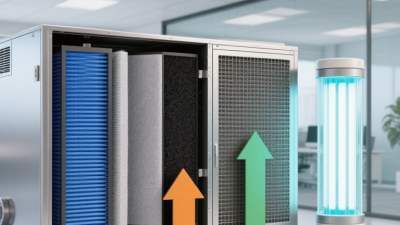
Selecting an air filtration system starts with matching the efficiency standard to the actual risk. MERV 13, measured under ASHRAE 52.2, can capture many fine particles in commercial ventilation. It suits offices, schools, and public buildings with adequate airflow. ISO 16890 reports performance by particle size, such as ePM1 or ePM2.5. This approach helps buyers compare filters against local pollution conditions.
HEPA filtration is different. A true HEPA filter typically removes 99.97% of 0.3-micrometer particles under its specified test method. That figure is powerful, but it does not guarantee clean air in every room. Poor sealing, damaged frames, or insufficient fan capacity can reduce real performance. Check the complete unit, not only the filter label. Airflow matters greatly.
Ask suppliers for test reports, pressure-drop data, dimensions, replacement intervals, and operating limits. A filter that looks efficient may consume excessive energy when clogged. I have seen specifications hide this problem. It deserves closer review. Buyers should also confirm whether MERV, ISO, or HEPA results use comparable testing conditions. They often do not. Consider humidity, dust loading, noise, maintenance access, and local electrical requirements. A practical site trial can reveal vibration, leakage, and reduced airflow before a large purchase. Mistakes still happen, especially when buyers compare percentages without checking test methods.
Buy Air Filtration Systems: 7 Tips for Global Buyers — Match MERV 13, ISO 16890, or HEPA’s 99.97% Efficiency
| Tip |
Buying Dimension |
Verified Technical Information |
Recommended Buyer Action |
| 1 |
Match the rating system to the market |
MERV ratings are based on ASHRAE 52.2 test methods. ISO 16890 reports efficiencies as ePM1, ePM2.5, and ePM10. These classifications are not direct one-to-one equivalents.
|
Request the applicable test standard, efficiency category, laboratory report, and product designation required in the destination country.
|
| 2 |
Select the required particle efficiency |
MERV 13 filters are commonly specified for enhanced removal of fine particles in HVAC systems. Under the ASHRAE 52.2 framework, MERV 13 performance is evaluated across particle-size ranges from approximately 0.30 to 10 micrometres.
|
Use MERV 13 only when the air-handling unit can accommodate its airflow and pressure-drop requirements. Do not describe it as equivalent to HEPA.
|
| 3 |
Understand ISO 16890 classifications |
ISO 16890 classifies general ventilation filters according to average removal efficiency for particulate matter smaller than 1, 2.5, and 10 micrometres. The reported ePM values depend on the particle-size distribution used in testing.
|
Compare products using the same ISO 16890 category and airflow condition. Avoid converting an ePM rating into a precise MERV or HEPA value without validated test data.
|
| 4 |
Confirm whether HEPA is necessary |
A typical high-efficiency particulate air filter defined under widely used U.S. criteria removes at least 99.97% of particles at the most penetrating particle size of 0.3 micrometres when tested under the specified conditions.
|
Specify HEPA only for applications that require that level of filtration. Check the complete filter assembly, gasket, housing, and installation for leakage control.
|
| 5 |
Check airflow and pressure drop |
Pressure drop increases as a filter loads with dust and can reduce system airflow. A filter’s efficiency cannot be evaluated independently from its rated airflow, initial pressure drop, final pressure drop, and fan capacity.
|
Require a pressure-drop curve at the intended airflow. Confirm that the fan, ductwork, filter frame, and sealing method can support the selected filter throughout its service life.
|
| 6 |
Evaluate energy and operating cost |
Total cost includes purchase price, transport, installation, fan energy, monitoring, labor, and replacement filters. A higher-efficiency filter may create additional resistance if the system is not designed for it.
|
Compare life-cycle cost rather than unit price. Record energy assumptions, operating hours, filter-change intervals, and the electricity tariff used in the calculation.
|
| 7 |
Verify documentation and installation quality |
Published efficiency applies to the tested configuration and conditions. Bypass air around the filter, incorrect dimensions, damaged media, or poor gasket compression can substantially reduce real-world performance.
|
Request dimensional drawings, installation instructions, batch traceability, test reports, safety data where applicable, and a clear procedure for inspection and replacement.
|
Important comparison note: MERV 13, ISO 16890 ePM classifications, and HEPA performance are based on different test methods and reporting conventions. Use the original test standard and application-specific airflow data when making a purchasing decision.
Size CADR with AHAM’s Two-Thirds Room-Area Rule
When global buyers size an air filtration system, CADR should match the room, not the product box. AHAM’s AC-1 guidance uses a practical rule: choose a smoke CADR equal to at least two-thirds of the room’s floor area. A 180-square-foot bedroom therefore needs about 120 cubic feet per minute (CFM). The calculation assumes an eight-foot ceiling and typical residential conditions. Higher ceilings require more capacity.
Measure the usable room area carefully.
A 20-square-meter office is about 215 square feet, so the target CADR is roughly 143 CFM, or 243 cubic meters per hour. I once sized a unit by floor area alone. The tall ceiling made the result weaker than expected. That mistake still deserves attention. Real performance also depends on door gaps, outdoor pollution, and filter loading.
The U.S. Environmental Protection Agency explains that portable cleaners can reduce airborne particles when properly sized and operated. The World Health Organization’s 2021 air-quality guidelines set a 24-hour PM2.5 reference level of 15 micrograms per cubic meter. CADR does not guarantee that target, but it provides a measurable starting point. Buyers should compare the tested particle CADR, noise level, energy use, and replacement-filter availability. Ask for test conditions. Certification methods differ across markets, and advertised airflow may not equal filtered airflow. Bigger is not always better.
Compare Energy, Noise, and Filter Costs over the Product Life
When buying air filtration systems globally, compare operating costs before purchase price. The International Energy Agency reports that buildings consume about 30% of global final energy. Ventilation and filtration can materially affect that demand. The U.S. Department of Energy estimates that HVAC systems may represent roughly 40% of commercial building energy use. A higher-efficiency motor helps, but pressure drop matters more than many buyers expect. Record airflow, motor power, operating hours, and electricity tariffs. For example, a 1-kilowatt fan running 8,000 hours uses 8,000 kilowatt-hours annually. Small pressure losses become expensive over time.
Noise also deserves measurement, not promises. Ask for sound-power data under the actual airflow condition, preferably tested under recognized acoustic procedures. A quiet showroom unit may become intrusive beside a sleeping area or open office. Filter costs need equal attention. Compare replacement price, service labor, shipping, disposal, and expected service life. ASHRAE Standard 52.2 provides a recognized method for evaluating filter performance, but efficiency alone does not reveal lifetime cost. Higher filtration can increase resistance if the housing is undersized. It may also reduce fan performance.
Use a five-year or ten-year ownership model. Include seasonal dust, humidity, local energy prices, and spare-filter availability. Real buildings are messier. Reported service lives may assume cleaner conditions than your site provides. I would also request test records, warranty terms, and calibration details. Independent verification is worth the extra effort, although it can delay procurement. That trade-off is often overlooked.
Verify CE, UL, Voltage, Warranty, and Replacement-Filter Access
Buy Air Filtration Systems: 7 Tips for Global Buyers
Before purchasing, verify the compliance documents, not only the printed marks. A CE mark indicates conformity with applicable European requirements; it is not always independent safety certification. For North American projects, request the relevant UL evaluation, certificate number, and product scope. Check whether the document covers the complete air cleaner, power supply, and controls. A copied logo proves little.
Voltage errors create expensive problems.
Match the nameplate voltage, frequency, plug, and permitted tolerance with the installation site. Many regions use 220–240V at 50Hz, while others use 110–120V at 60Hz. Ask for test reports under the intended electrical standard. Also compare clean air delivery rate with room size. The U.S. EPA recommends portable cleaners with smoke CADR approximately two-thirds of the room’s floor area in square feet. Bigger is not automatically better.
Warranty language deserves careful reading. Confirm coverage duration, labor terms, shipping responsibility, and exclusions for continuous operation. Replacement-filter access matters more than attractive housing. The WHO 2021 Global Air Quality Guidelines set annual PM2.5 guidance at 5 µg/m³, highlighting the need for dependable filtration performance. Ask how filters are identified, stocked, and dated in your market.
A filter that cannot be obtained is a failure. I have seen buyers approve equipment before checking this detail. That decision often returns as downtime, higher costs, and uncomfortable compromises.